Fifteen years ago, when I started running Google Ads campaigns, the work required real expertise. You had to understand match types deeply. The difference between broad, phrase, and exact wasn't cosmetic, it determined whether your budget survived the week. You had to build account architecture by hand, think carefully about Quality Score, manage bids manually, interpret search term reports with genuine analytical judgment. The barrier to doing this well was high. That barrier protected everyone who had climbed it.
Over the following decade, Google systematically automated that expertise away. Smart Bidding absorbed manual bid management. Performance Max collapsed campaign architecture into a single structure. Responsive Search Ads replaced the careful craft of ad copywriting with machine-selected combinations. Each release was framed as a feature. Each one transferred a piece of what specialists knew into the platform itself.
I watched this happen in real time, from inside thousands of accounts. And I understood what it meant, even when the industry preferred not to.
We Were Never the Agency That Resisted Change
I want to be clear about something before I go further. AdVenture Media has never been the agency that resisted automation. When Smart Bidding arrived and most agencies were coaching clients to stay on manual CPC, we were testing it aggressively, understanding its limits, learning where it won and where it failed. When Performance Max launched and the industry's reaction was skepticism and avoidance, we were inside it early. We have always believed that practitioners who move toward new tools first, who understand them deeply rather than dismissing them, hold a structural advantage over everyone who waits.
But the shift happening now is different in magnitude. Categorically different.
Last Month, Google Completed the Picture
Ads Advisor is a Gemini-powered AI agent living directly inside your Google Ads account. It creates campaigns from a brief. It writes headlines, generates images, sets bids, allocates budget, diagnoses performance issues, and implements changes without a human touching a single setting.
Read Google's own language carefully. They call it an "agentic expert." They describe it as offering personalized recommendations for new and existing campaigns and implementing them on behalf of the advertiser. This is precise language. On behalf of. The advertiser gives a goal. The system executes.
The economics here are worth understanding clearly. Google has always wanted direct relationships with advertisers. Every dollar an agency captures is a dollar that flowed through Google's platform but stopped before reaching Google's revenue line. Every hour an agency spends persuading a client toward efficiency is an hour working against Google's interests. The intermediary existed because the system was too complex to navigate alone. Ads Advisor is Google's answer to that complexity, and it is exactly what you would expect Google to build if you thought carefully about their incentives for long enough.
This is the roadmap. The trajectory is unambiguous.
The Expertise That Built This Industry Was Always Two Things
The knowledge that every serious practitioner accumulated over years was always two things compressed together into one job description, one invoice, one professional identity.
The first was operational mastery. Knowing how the platforms worked. How to structure campaigns, set targets, manage bids, read the data, build the architecture. This knowledge had genuine value because the systems were genuinely complex, and complexity rewards expertise. But operational mastery is ultimately learnable by a sufficiently sophisticated model. It is the kind of knowledge that lives in patterns, and patterns, at sufficient scale, yield to machine learning. Google has been training on this knowledge for years, across millions of accounts, with a feedback loop no human team could replicate.
The second kind of knowledge is different in kind, not just degree. It is what you develop from years of sitting across from real businesses, in real competitive environments, with real money on the line and real consequences for being wrong. It is the ability to read a market that has shifted before the data reflects it. To know that the offer is broken, that the landing page is lying to the customer, that the real problem is upstream of the account. To sense when a client is about to make a decision that will cost them the next six months, and to say so in a way that lands. To bring creative judgment to a problem that every algorithm in the world would solve conventionally.
That knowledge lives in the person who earned it. It accumulates through specific experiences, through being right and wrong in specific situations, with specific consequences. It produces something closer to instinct than analysis because the read is already forming while others are still pulling the report.
Which Side of That Line Were You On?
If your professional identity was built on operational mastery, on being the person who knew how to run the platforms, then this transition is genuinely difficult, and I think it deserves to be named as such rather than dressed up as an opportunity. The work you built expertise in is being absorbed. That is real.
If your professional identity was built on the second kind of knowledge, on judgment, on business acuity, on the creative and strategic read that platforms cannot replicate, then AI just did you an enormous favor. It automated everything beneath you. The desk is clear. What remains is the work that always mattered most and that no model trained on yesterday's data will ever get ahead of.
The Marketer Who Wins Holds All Three Things at Once
Here is what I actually believe about who dominates this industry over the next decade.
Deep operational understanding, because you have to know how the machine works to know where it breaks and where it lies to you.
Real strategic judgment, the accumulated read on businesses, markets, and people that no platform will ever train away.
And genuine mastery of AI tools, the ability to build infrastructure that runs the execution automatically, integrates your proprietary knowledge, and compounds over time in ways that a competitor starting fresh simply cannot replicate.
Any one of those alone is insufficient. Operational mastery without judgment is what Ads Advisor already does. Judgment without AI fluency is a brilliant analyst in a room full of people who have automated everything you still do by hand. AI fluency without the underlying expertise produces sophisticated systems pointed at the wrong problems.
The combination is what's irreplaceable. And the combination is precisely what most people are not building, because building it requires moving deliberately toward something unfamiliar while the familiar work is still paying the bills.
This Is Why I'm Running the March 24th Workshop
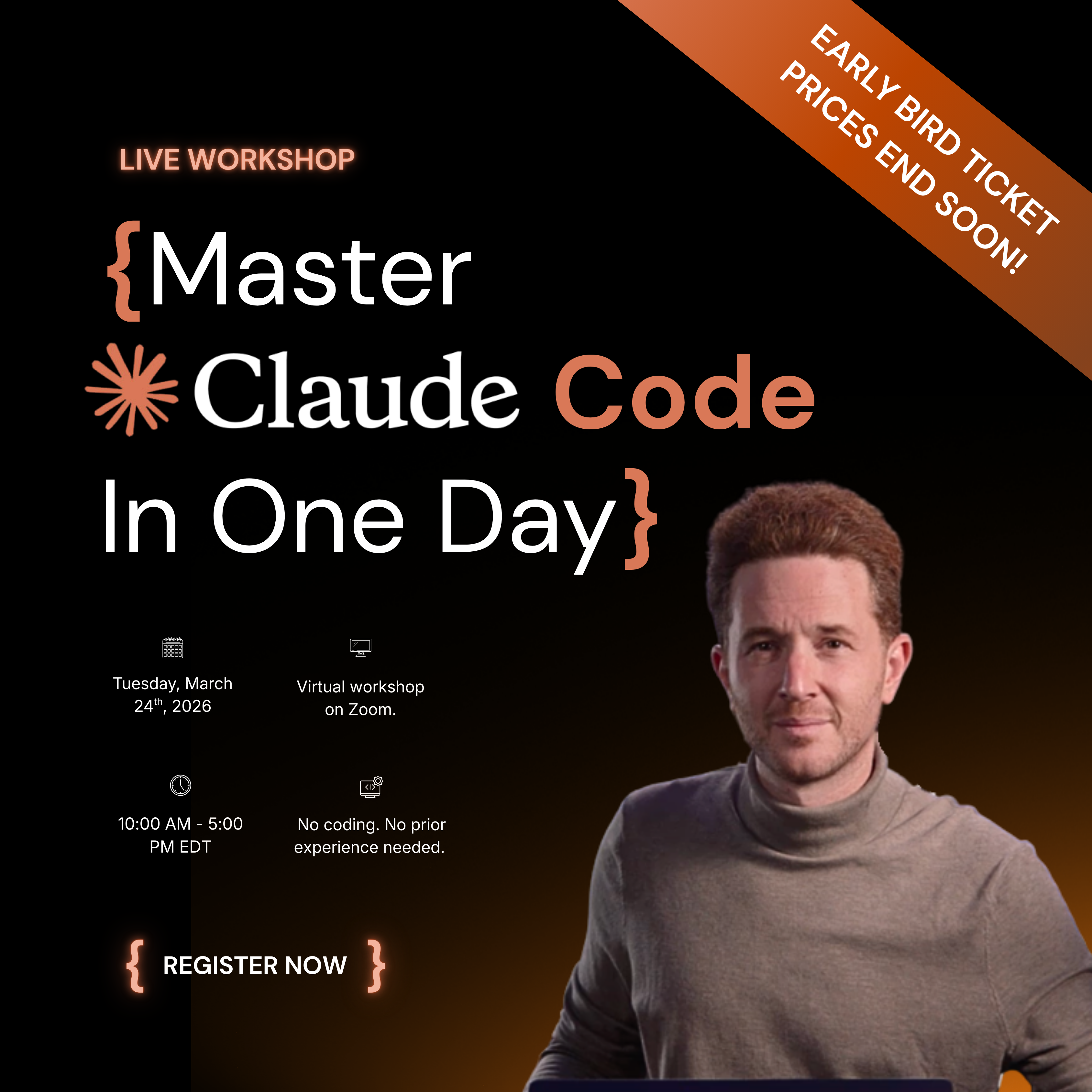
A full day, live, building with Claude Code. By the time you leave, you will have built systems that run real work automatically. Reporting, monitoring, analysis, workflows that previously ate hours every week. Systems you designed, that carry your logic, your standards, your years of hard-won knowledge baked into their architecture.
This is the practical foundation of what the dominant marketer looks like in 2026 and beyond. You will leave this workshop ahead of the vast majority of practitioners in this industry. Ahead in understanding, ahead in capability, ahead in the infrastructure that compounds while everyone else is still running manually.
Seats are limited. And because you are a Modern Marketing Institute member you get 60% off on top of the early bird pricing with code MMI60. Early bird pricing closes March 17th.
— Isaac
Founder, Modern Marketing Institute & AdVenture Media Group
P.S. March 17th is the early bird cutoff. The workshop is March 24th. There is not much runway here. Either you are in, or you are watching from the outside while others build what you should be building.

Responses